
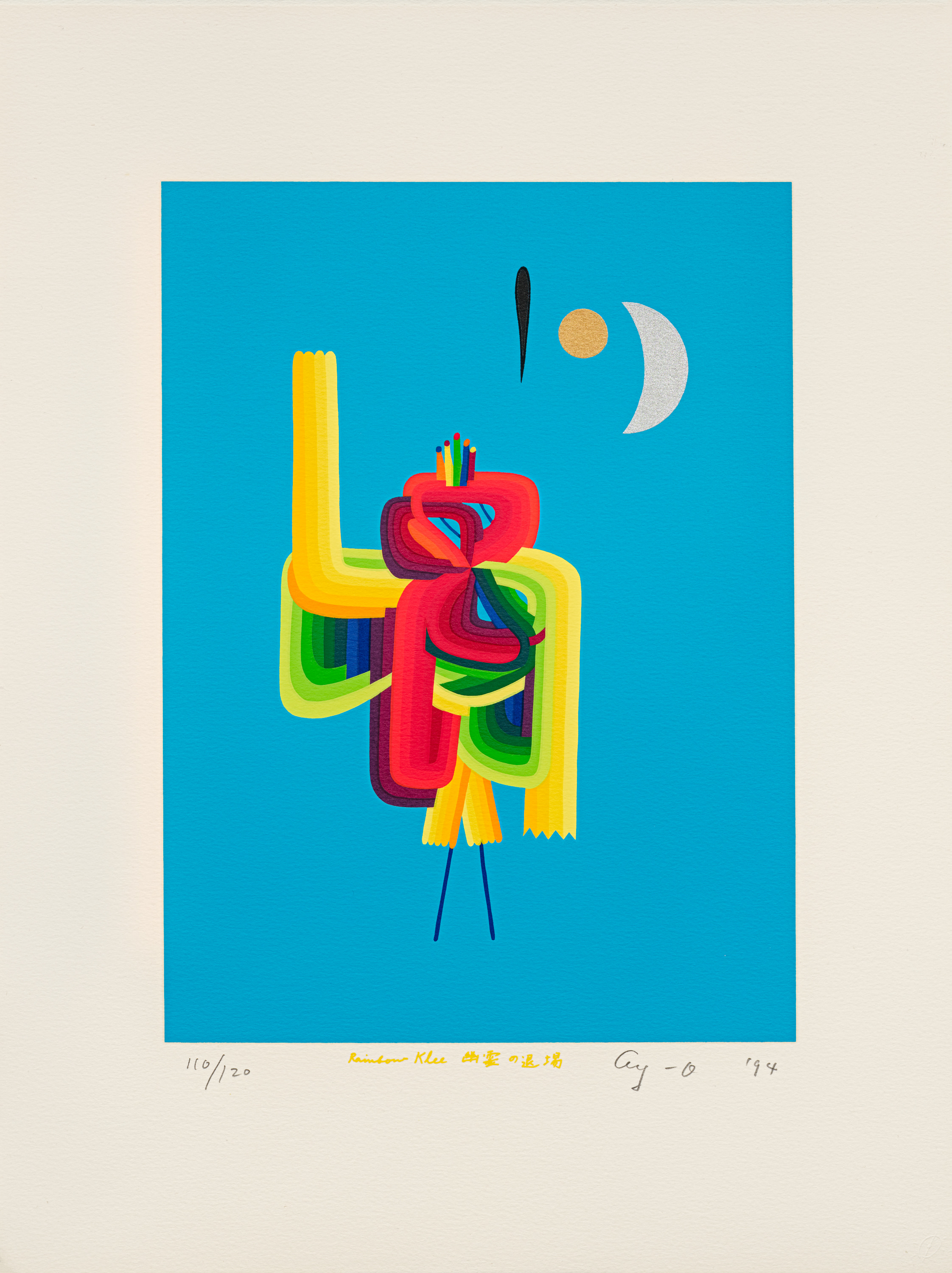
Ay-O Prints: 380–780nm
Ay-O Prints: 380–780nm
2026 Nov 14 — Dec 19
Venue: No.10, shaoxing S. St., Taipei, Taiwan
Ay-O Prints: 380–780nm
2026 Nov 14 — Dec 19
The Rainbow Man Beyond Sight: A Fluxus Artist of the Five Senses
Ay-O (b. 1931), the Japanese artist known worldwide as the “Rainbow Artist” and a core member of the international Fluxus movement, will present Ay-O Prints: 380–780nm at Hiro Hiro Art Space in Taipei from November 14 to December 19, 2026, featuring more than 20 silkscreen prints. The title refers to the range of light visible to the human eye, from violet at about 380 nanometers to red at about 780 nanometers. Ay-O applies the colors of the visible spectrum to his work in their natural order, making the entire spectrum his creative method. Few people know that this avant-garde artist, who reinterpreted the world through the rainbow, attended elementary school in Taiwan as a child. Following his 2024 solo exhibition A Rainbow Frenzy at the gallery, this show focuses on the medium in which he has been most prolific and which is most accessible to collectors: printmaking. Starting from the prints, the exhibition invites viewers to understand the whole way of seeing that lies behind the rainbow.
A “Strange” Avant-Garde Artist
Ay-O was born Takao Iijima in Ibaraki Prefecture, Japan, in 1931. His father was a pilot in the Japanese Navy, and the family moved with his postings; in second and fifth grade, Ay-O attended elementary school in Taiwan under Japanese rule. He once described his happy days in Taiwan as being like a rainbow.
In 1953, while studying at Tokyo University of Education (now the University of Tsukuba), he joined the Demokrato Artists Association, the avant-garde group led by Ei-Q (1911–1960), and it was then that he adopted the name “Ay-O” (靉嘔). The pronunciation comes from the five Japanese vowels: he asked his friends each to choose from a, i, u, e and o, and most chose a, i and o. Choosing a name, he said, was like choosing colors: he wants to use everything, and that is simply how he makes choices. The Chinese characters have their own story. 靉 (ai) describes billowing clouds, and the works he was painting at the time happened to feature clouds; 嘔 (o) comes from Nausea, the novel by the existentialist philosopher Jean-Paul Sartre (1905–1980). He also chose the complicated character 靉 because it looked suitably strange. “Strange” is his favorite joking word for himself and for the artist friends he admires. To him, strange is praise for the avant-garde: it means no one has done it before. Even in his nineties, he still says that what he is looking for is “a method no one has ever used.”
After graduating in 1954, he moved to New York in 1958, drawn by his admiration for Marcel Duchamp (1887–1968) and Jackson Pollock (1912–1956). In 1961 he turned away from Action Painting, then the dominant style, and built a room out of canvas: Tea House. Yoko Ono (b. 1933) loved the work and brought many friends to see it, including the sculptor Isamu Noguchi (1904–1988). Tea House turned the materials of painting into a space one could walk into, pushing the boundaries of “painting” and blurring the lines between painting, sculpture and architecture. It can be seen as one of the forerunners of installation art: the term “installation art” did not come into common use until the 1970s, yet Ay-O was already doing it about a decade earlier. Introduced by Yoko Ono, he then joined Fluxus, founded by George Maciunas (1931–1978), becoming one of its core members and working alongside Nam June Paik (1932–2006), Yoko Ono and others. Inspired by John Cage (1912–1992), he brought sound, everyday actions and audience participation into art.
Further reading: Ay-O Oral History
1966, Rainbow Tactile Room: One of the Earliest Multi-Sensory Works at the Biennale
In 1966, at the age of 35, Ay-O represented Japan at the 33rd Venice Biennale with Rainbow Environment No. 3. Because it centers on touch, the work is also widely known as Rainbow Tactile Room.
The entire room was wrapped in wave-like bands of rainbow color, and 65 Finger Boxes were set into the walls. Visitors had to put their fingers into holes they could not see into and guess by touch what was hidden inside.
Further reading: Ay-O’s Tactile Devices: Fluxus Exploration of Touch by Aga Wielocha
In Sculptural Materiality in the Age of Conceptualism, the American art historian Marin R. Sullivan notes that, judging by the volume of press coverage, Rainbow Tactile Room was the most discussed and most controversial work of that Biennale, and the sensation spread the name “Rainbow Artist” around the world. Putting their fingers into the holes in the wall, visitors might touch powder or foam, receive an electric shock, or trip a switch that played a Beatles song; at the foot of the wall, a wooden box labeled “Place hand in here” held cold water, and curious visitors often pulled their hands back with a shriek. Ay-O’s room and Yayoi Kusama’s Narcissus Garden, which Kusama (1929–2026) presented on her own initiative on the lawn outside the Italian Pavilion that same year, both mixed media and invited audience participation, together challenging established definitions of “fine art.” Even the most conservative critics had to admit that art was leaving behind the traditional modes of painting and sculpture. The British curator and critic Lawrence Alloway (1926–1990), in his 1968 history of the Biennale, also described Rainbow Tactile Room as “one of the first multi-sense art works to be seen in the Biennale (rainbow color and invitation to touch) and certainly a sign of many environmental displays to come.”
The immersive, interactive exhibitions that are everywhere today were something Ay-O had already achieved nearly 60 years ago.
Embed from Getty ImagesKnowing the World Through the Five Senses
Ay-O resolved to make art with all five senses. In a 2023 interview with Bijutsu Techo, he gave an example:
“When I paint a sunset, I paint it a vivid red. If a viewer touches it and can feel warmth, that means I have captured the sunset more accurately.”
We come to know the world through our five senses in the first place, so a painting should not speak only to the eyes. In his view, straight lines and composition are concepts invented by humans; once every man-made rule is stripped away, the only thing left that people can trust is the senses themselves. He even proposed a “sixth sense”: when touch and sight collide, a new kind of perception emerges.
Why the Rainbow: Covering Existing Images with the Spectrum
Within Ay-O’s system of the five senses, the rainbow is responsible for sight. He once explained why to the critic Kiyoshi Honnami: life is short, and he wanted to complete his work on all five senses. To “get through” sight as quickly as possible, the method he came up with was to follow the order of visible light, use every color at once, and cover the subject entirely. In other words, the rainbow is his total answer to vision, freeing him to move on to touch, hearing and the other senses. The method follows a clear logic.
First, the rainbow is not a subject but a method. After his first solo exhibition in New York in 1962, he stopped inventing images of his own and stopped working with points, lines and planes, methods derived from the definitions of geometry. Instead, he covered existing images with the spectrum visible to the naked eye. As the Museum of Contemporary Art Tokyo points out, his rainbows are not meant to depict “light” or “a rainbow” as natural phenomena; rather, they borrow the order of the spectrum that already exists in nature, strip images of their original colors, and lay down every color in sequence from red to violet.
Second, it has strict rules. Rainbow bands can only be laid along parallel lines, so he prefers source images that are rigorous and clearly structured. Masterpieces, he says, are actually the easiest to turn into rainbows, while decorative pictures do not take them at all. As he also put it: “The rainbow has a direction.”
Finally, he opposed the idea that “only black and white is art.” At the time, the top prizes at print exhibitions went almost entirely to black-and-white works. He believed black and white conceals reality, and that to see the real world one must see it in color.
Not Inventing, Only Re-illuminating: Ay-O’s Philosophy
What Ay-O gave up was “inventing” new images, not making art with his own hands. He was deeply influenced by Duchamp. In 1917, Duchamp signed a ready-made urinal, titled it Fountain and submitted it to an exhibition. From then on, art history began to accept that an artist need not make a work by hand, and that “choosing” is itself a form of creation; this is also seen as one of the starting points of conceptual art. Ay-O followed this line of thought, but he cared more about what viewers could directly see and feel. The opposite of abstract, he said, is concrete, and concrete is what he wanted to make: the things that actually exist around us in daily life, things we can see and touch. So he selected existing images from ukiyo-e, famous paintings and illustrated encyclopedias, and transformed them with the rainbow.
Choosing images the public knows well was a way to communicate. Ay-O has said that he makes art in the hope that others will understand his ideas. When he first arrived in New York, he also painted in the Action Painting style, but felt that abstraction made it hard for people to understand what he wanted to say, so he turned to images anyone could read. He deliberately chose much-loved subjects such as peacocks, tigers and dinosaurs, drawing viewers in through familiarity and then leading them into unexpected realms of imagination.
The rainbow carries two layers of meaning. The first is equality: Buddhist statues, mantises, Klee’s paintings and dinosaurs are all rendered in the same spectrum, so no subject ranks above another, echoing the Fluxus spirit that “art belongs to everyone.” The second is the act of seeing itself: the spectrum is every color the human eye can see, so when an object’s original colors are replaced by light, viewers see not only a peacock but also become aware that they are seeing.
In other words, Ay-O no longer invents new images; he borrows images that already exist in the world and re-illuminates them with one and the same spectrum. This is a way of seeing the world anew, not just a picture.
Prints: One Color, One Screen, a Rainbow Printed Slowly
Printmaking is the form in which Ay-O has been most prolific. In the 1950s he took part in the Small Collectors’ Movement launched by the critic Sadajiro Kubo (1909–1996) and others, which promoted prints made by artists’ own hands to the general public at affordable prices. He made his own etching inks and printed his lithographs himself, and the savings from print subscription sales paid for his journey to New York.
For Ay-O, prints are also a way of bringing art into everyday life. He has said plainly that prints are made to be bought; entering ordinary homes at approachable prices echoes the anti-elitist spirit of Fluxus, and recalls the ukiyo-e prints that common people could afford in their day. But affordable does not mean crude. The color separation of silkscreen suits his spectrum system, which is built on parallel lines. And while silkscreen is often seen as fast, mass-produced commercial printing, he went the other way, preferring to print color by color in rich, heavy oil-based inks. Each color takes about three days to dry, and a complex work can take three to six months to complete.
Covering an image in rainbow may look like simply changing its colors, but the technical skill involved is greatly underestimated. Every band must shift in spectral order from red to violet, while the direction and density of the bands must also build layers of foreground and background, volume and overlap. In other words, using nothing but the arrangement of the spectrum, Ay-O has to redraw the space and mass of an entire picture.
This way of working also depends on the craft of the printers. At the time, prints were often dismissed as “half-paintings,” but to Ay-O, a printer is not a technician who simply follows instructions but a co-creator of the work. So with the silkscreen printers Tokuzo Okabe and Kenryo Sukeda, every time an edition was printed, the sheets were split in half: half for Ay-O, half for the printer.
Ay-O usually works with a 24-color gradation, one screen per color. Kanzen Chōaku (Reward the Good, Punish the Evil), shown in this exhibition, adds an extra red as well as gold, silver and black, for 28 colors in total. Each sheet therefore required 28 screens and 28 printings, making it the most complex work Sukeda ever printed. As he cut the stencils with a magnifying glass, Sukeda thought of Ay-O numbering every color, cell by cell, on the draft, and was filled with admiration for that focus and the time it took. In the picture, the document being handed to King Enma, the lord of Hell said to judge the dead, bears the names of both Ay-O and Sukeda. Ay-O joked that since the two of them were going to hell anyway when they died, they might as well get the paperwork done in advance. And if 28 screens sounds like a lot, Rainbow Hokusai, which won the National Museum of Modern Art, Tokyo Prize at the 7th Tokyo International Biennial Exhibition of Prints in 1970, took no fewer than 500 silkscreen screens and a full year of the printer’s work. The set is now in the collections of the British Museum, the Smithsonian’s National Museum of Asian Art, the Art Gallery of New South Wales, the National Museum of Modern Art, Tokyo, and the Museum of Contemporary Art Tokyo.
Kit Brooks, curator at the Smithsonian’s National Museum of Asian Art, notes that Ay-O treats prints not as flat compositions but as “immersive surfaces.” Even in a print hanging on a wall, what he pursues is an experience that surrounds the viewer, the same goal as his environments that can be walked into and touched.
In the Exhibition: Buddhas, Mantises, Paul Klee and Everything Between 380 and 780nm
The exhibition ranges from Ay-O’s most iconic works, Mr. & Mrs. Rainbow, Mantis and Tiger, to works such as RAINBOW HOLE and Iroha that explore different linear forms of the rainbow itself, showing how many variations a single spectrum can take.
A highlight of the exhibition is the Rainbow Klee series, in which Ay-O takes paintings by Paul Klee (1879–1940) as his source and covers them anew with the spectrum: A Garden for Orpheus is based on Klee’s Ein Garten für Orpheus, Exit of the Ghosts on Gespenster-Abgang, East-Classical Coastal Landscape on ost-klassische Küsten-Landschaft (1936), and City Surrounded by Lagoons on Lagunenstadt. Klee’s compositions of line and color fields become layer upon layer of rainbow in Ay-O’s hands, a dialogue across time between two masters of color. The exhibition also includes Peacock Looking Back, Hitohada Dainichi, and subjects such as rabbits, phoenixes and dinosaurs. From Buddhist imagery and auspicious creatures of East Asia to prehistoric life, all appear under the same spectrum.

Ay-O was born Takao Iijima in 1931 in Ibaraki, Japan, and later moved to New York City in the late 1950s. He became a core member of the international avant-garde art movement Fluxus, working alongside founder George Maciunas, Yoko Ono, Emmett Williams, Nam June Paik, and others. He played a pivotal role in spearheading the international recognition of postwar Japanese contemporary art.
Ay-O sought to explore the fusion of all senses—hearing, touch, vision, smell, and taste—within his artworks. This exploration led him to create his famous tactile experience series, “Finger Boxes,” where one can sense sounds or different textures by inserting a finger. From the 1960s onward, Ay-O developed his distinctive artistic expression characterized by rainbows. Known as a “Rainbow Artist,” the rainbow itself was not his thematic focus but rather a representation of “vision” through colors. He employed the concept of the “rainbow” to infuse his works with colors spanning the entire visible spectrum. This approach allows viewers to engage more senses through the visual stimulus, leading to an experience of “multi-sensory” engagement guided by the rainbow.
Ay-O’s works have garnered international acclaim and have been widely collected by institutions such as the Museum of Modern Art in New York, Centre Pompidou, the British Museum, the Whitney Museum of American Art, the Art Institute of Chicago, the Smithsonian’s National Museum of Asian Art, the Walker Art Center, and the Museum of Contemporary Art Tokyo, among others.
Works


CV
1931
Born in Ibaraki prefecture
1950–1954
Tokyo Kyoiku University (the present University of Tsukuba) Art Department, Tokyo, Japan
1953
Joined the Demokrato Artists Association
Group show “The Second Demokrato Exhibition” at Maruzen Gallery, Tokyo
1954
Teaching at The Third Shimura Junior High School in Itabashi-ku, Tokyo.
1955
Founded Group Jitsuzaisha (The Existentialists) with Masuo Ikeda, Hiroshi Manabe, and Yasushi Horiuchi
First solo show “Young Friends” at Galerie Takemiya, Tokyo
1956
Married Ikuko Yoshida
1958
Moved to the United States
1961
Was introduced to George Maciunas by Yoko Ono, started participating in Fluxus movement
1962
Solo show “Ay-O First One Man Show in U.S.A.” at Gordon’s Fifth Avenue Gallery, New York
1963
Officially joined Fluxus art group
1964
Solo show “Ay-O’s Orange Box Tactile Environment/Finger Box” at Smolin Gallery, New York.
Started “Rainbow Happening” as part of the Fluxus event
1966
“Adam and Eve” (Environmental painting) shown in the Group show “The Seventh Japanese Contemporary Art Exhibition” at the Tokyo Metropolitan Museum of Art
The Grand Prix at the Third Nagaoka Contemporary Art Award, Japan
Represented Japan with ‘Rainbow Environment No. 3’ at the 33rd Venice Biennial
Appeared in Allan Kaprow’s book “Assemblage, Environments & Happenings” as one of the early environmental artists along with Yayoi Kusama and George Segal.
1967
Special Prize at the Vancouver International Print Biennial, Canada.
1969
The Grand Prix at the 4th Japan Art Festival, The National Museum of Modern Art, Tokyo, Japan
The National Museum of Modern Art, Kyoto Prize in the 9th Contemporary Japanese Art Exhibition, Japan
1970
“Rainbow Environment No. 7 (Tactile Rainbow Room)” exhibited at the World Exposition ’70 in Osaka, Japan
National Museum of Modern Art, Tokyo Prize at the 7th International Biennial Exhibition of Prints, Tokyo
1971
Mr. U. Prize at the 4th Contemporary Japanese Sculpture Exhibition, Japan
The Bridgestone Museum Prize at the 10th Contemporary Art Exhibition of Japan
The Minister of Foreign Affairs Prize at the 6th Japan Art Festival, New York
The Brazil Bank Prize at the 11th Sao Paulo Biennial, Brazil
1972
Museum of Art, Łódź Prize at the 4th Krakow International Print Biennial, Poland
Prize at the 3rd Exposition Internationale de Dessins Originaux, Rijeka, Croatia
1973
Fluxus “FLUXSHOE” exhibition, Oxford, England
1974
Group show “Japan Show” at Louisiana Museum of Modern Art, Denmark
1975
Secretariat d’Organization Prize at the 11th International Exhibition of Prints, Moderna Galerija, Ljubljana, (former) Yugoslavia
1976
“Then, Mr. Ay-O Got Drunk by Rainbow—38 silkscreen prints” exhibited and purchased by the Museum of Modern Art, New York
1978
Prize at the 6th Exposition Internationale de Dessins Originaux, Rijeka, Croatia
1979
Solo show “The World of Ay-O” at the Ikeda Museum of 20th Century Art, Japan
1980
Solo show “Ay-O Prints” at the Fukuoka Art Museum, Japan
National Museum of Art, Warsaw Prize at the 1st International Drawing Triennial
National Museum of Art, Wroclaw Prize at the 1st International Drawing Triennial
Medal Prize at the 8th Krakow International Print Biennial, Poland
The Grand Prix at the 2nd Listowel International Print Biennale, Ireland
Prize at the 7th Exposition Internationale de Dessins Originaux, Rijeka, Croatia
1985
The Copper Prize at the 2nd Republic of China International Prints Exhibition, Taiwan
1986
Prize of Excellence at the Seoul International Prints Biennial, the National Museum of Contemporary Art, Seoul, South Korea
1987
“Rainbow Happening No. 17” (300 meter Rainbow Eiffel Tower Project), Paris
1990
The 22nd Japan Art Prize at Hotel Okura, Tokyo
1992
Solo show “Ay-O’s Objects and Prints” at the Fukuoka City Art Museum
1995
Awarded Purple Ribbon Prize (紫綬褒章) by the Emperor of Japan
2000
Solo show “Over the Rainbow, Rainbow Rainbow Ay-O” at The Museum of Modern Art, Ibaraki, Japan
2004
Solo show “Ay-O” at the Museum of Rainbow, Shimizu, Shizuoka, Japan
2005
Awarded The Order of the Rising Sun (旭日章) from the Japanese Government
2006
Solo show “Over the Rainbow: Ay-O Retrospective 1950-2006” at Miyazaki Prefectural Art Museum
2010
Solo show “Ay-O 1950s-2010: A Retrospective” at Tsukuba Museum of Art, Ibaraki, Japan
2012
Solo show “Ay-O: Over the Rainbow Once More” at Museum of Contemporary Art, Tokyo (Feb. 4-May 6), Niigata City Art Museum (July 28 – Oct. 8), Hiroshima City Museum of Contemporary Art (Nov. 3-Jan. 14, 2013)
2019
Solo show “AY-O: RAINBOW 88” at Karuizawa New Art Museum, Japan
Solo show “AY-O Screenprints by Kenryo Sukeda” at Whitestone Karuizawa, Japan
2022
Solo show “Rainbow: Ay-O Print Exhibition” at Whitestone Taipei, Taiwan
2023
Solo show “Ay-Ō’s Happy Rainbow Hell” at The Smithsonian’s National Museum of Asian Art, Washington, DC
Solo show “Ay-O: Hong Hong Hong” at M+ Museum, Hong Kong
2024
Solo show “Ay-O: A Rainbow Frenzy” at Hiro Hiro Art Space, Taipei, Taiwan
Collections
MoMA, Centre Pompidou, British Museum, Whitney Museum of American Art, Smithsonian National Museum of Asian Art, The Art Institute of Chicago, Walker Art Center, Museum of Fine Arts Boston, Brooklyn Museum, Detroit Institute of Arts, Portland Art Museum, Harvard Art Museums, M+ Museum, Art Gallery of New South Wales, Queensland Gallery of Modern Art, Museum of Contemporary Art Tokyo, National Museum of Modern Art Tokyo, National Museum of Modern Art Kyoto, Mori Art Museum, Irish Museum of Modern Art, RISD Museum, National Taiwan Museum of Fine Arts