
Ryoki KURASAKI Solo Show: The Garden of Traces
2022.Mar.5-Apr.10
Text by CHANG Hui-Hui
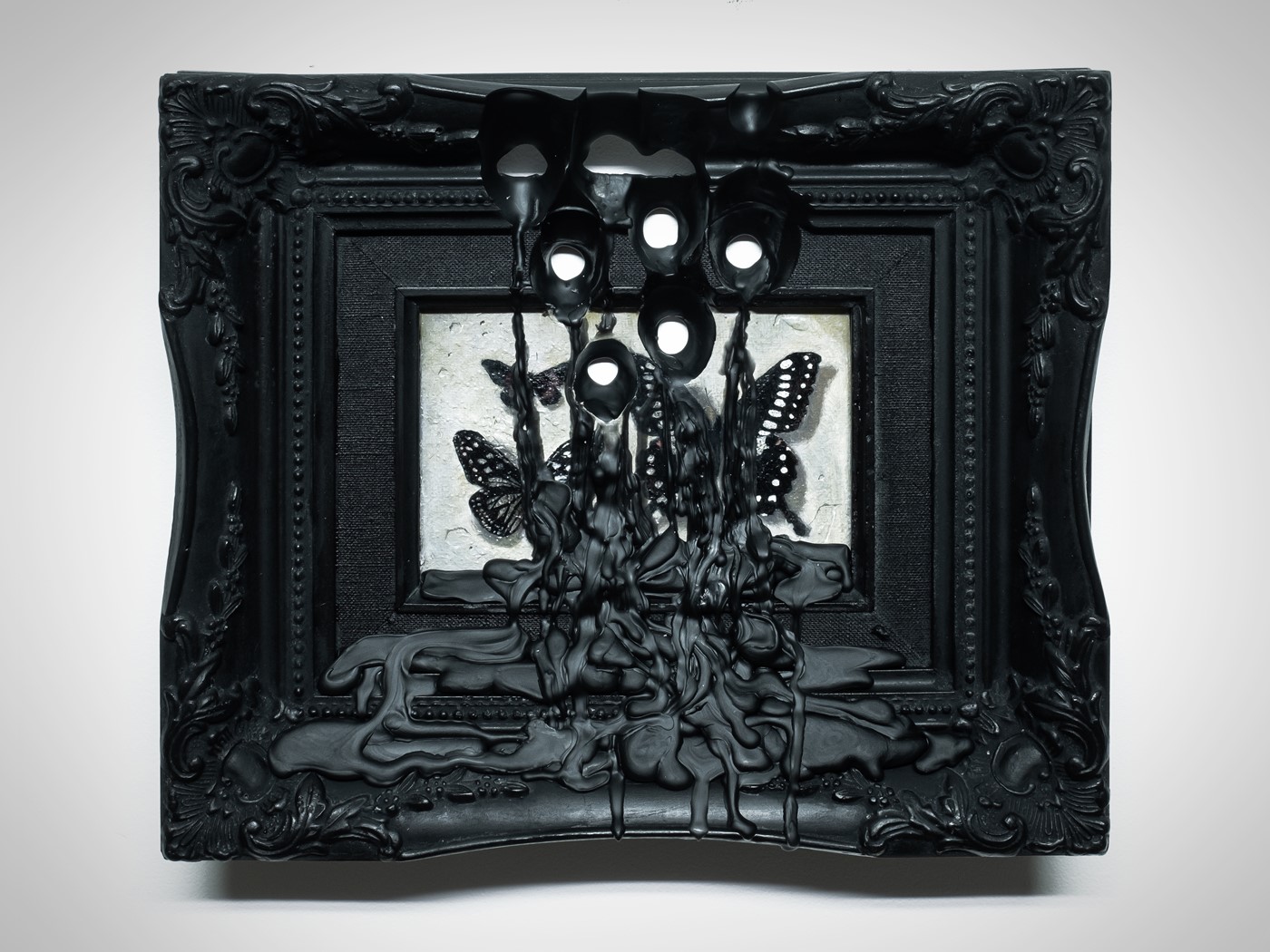
In the spirit of memento mori (a Latin idiom meaning “remember that your death is inevitable”) from the Middle Ages, Ryoki KURASAKI (b. 1995) brings us his solo exhibition The Garden of Traces at Hiro Hiro Art Space. Featuring oil paintings and wax, KURASAKI depicts remnants that survive the erosion from the flow of time, thereby unveiling a universality of life—humans inevitably exists in this vast garden we call “the world,” inevitably co-exist with other humans, inevitably leave behind marks of life, and inevitably meet their death.
The artistic creations stem from a simple fact—mortality, or “human’s inevitable death” It doesn’t matter how much attention you devote to trimming or how lovingly you shower the irrigation, all of us are plants and flowers in a garden—abiding by the order of time, blossoming and fading, until all that grows must inevitably extinguish. This is an iron law in Nature’s control over all living things; it is a fundamental formula of how the world operates, also the keyword that runs through KURASAKI’s artistic creation.
After graduating from Kyushi Designer Gakuin, KURASAKI first worked as an unorthodox commercial illustrator who would use oil paint in his commercial designs; after devoting himself to artistic work in 2017, in the following year, he developed his iconic form of expression—burning. At first, he applied the flame to cauterize eyes on his painting’s subjects; the blank spaces and burn marks in his Blindness series create an unsettling actualization of modern people blindly escaping death. Following that, in the Mortality series, he ignites tinder to melt the wax, taking a step further in giving time flow a form. He lets the flow of time trickle through pale skeletons, beautifully colorful butterflies, as well as ripe fruit and delicate fresh flowers. Thermal flow’s one-way irreversible process serves as a reminder to the viewers—that while time can give rise to life, it can also wash it away towards nothingness.
The death motif encompassed by the melted wax serves as a metaphor—by melting the seemingly solid frames into a fluid state, the artist formulates an image wherein reality is ambiguous and uncertain, symbolizing life’s ever-changing moments and its conformity to the inevitable—that is the order of time.


KURASAKI’s first name, Ryoki, was partly named after a perished close relative; as a teenager, he had, on multiple occasions, witnessed suicide on sight, prompting in him a deep understanding towards human beings—how they truly are “being-towards-death” as described by German philosopher Martin Heidegger. Only when bearing profound awareness towards our inevitable death will human beings develop complete comprehension towards life. The precocious young KURASAKI also observed early on how “in modern society, life and death have effectively become remotely existent in people’s daily lives while death is considered a taboo topic.” He states that, “It is meaningless to try and describe death to us—people who still stand far away from death—so, in my opinion, what we need is to realize our current status, that is, that the concept of death is still far ahead.”
KURASAKI is distinctly aware of his place as “the farthest insider.” What he strives to explore isn’t the nature of death, because there is no way out but to accept it. What fascinates him even more is “life in the moment,” which is encompassed by death; meanwhile, by illustrating life’s inevitable perish, the artist further presses his doubts towards the Creator through questions such as “Is art truly immortal?” and “Do artworks perish as well?” KURASAKI was inspired into reflection: “Death of an artwork depends on its concept and not material.”
The nature of time is, perhaps, the most mythical among all unsolved mysteries. On life, on death, on existence—the artist brings together these essential issues in The Garden of Traces, guiding us back to the essence of time to trigger in each of us our awareness towards life.


Overview

Ryoki KURASAKI was born in 1995 in Fukuoka, Japan. He concerns himself with the symbol of fire as the beginning and end of life and the ambiguity of its two sides. To put this interest into practice, he combines fire with portraits and still lifes in oil paintings. Through burning the eyes of the figures in his paintings, he expresses the blind sense of distance between life and death in today’s society, and attempts to approach the “values of the present” surrounding death. In recent years, he has continued his core creative concept by developing a series of three-dimensional works made of melted wax.
Works


Press


Visible and Invisible Death
CV
1995 Born in Fukuoka
2016 Graduated from Kyushu Designer Gakuin
Solo/Duo Exhibition
2022
“The Garden of Traces”, Hiro Hiro Art Space, Taipei, Taiwan
2020
Ryoki KURASAKI, Kurumi KOTANI Duo exhibition: “there-was”, DMOARTS, Osaka, Japan
2019
“Remains”, Gallery Kogure, Tokyo, Japan
“Traces Of The Soul”, DMOARTS, Osaka, Japan
2018
“A SIGN OF EMOTION”, Masataka contemporary, Tokyo, Japan
Group Exhibitions
2021
“3331 ART FAIR 2021”, Tokyo, Japan
“ART FAIR ASIA FUKUOKA 2021”, Fukuoka, Japan (Gallery Kogure, Tokyo, Japan)
“Kyushu New Art”, Fukuoka, Japan
“Art NAGOYA 2021”, Aichi, Japan (Gallery Kogure, Tokyo, Japan)
“ART FAIR TOKYO 2021”, Tokyo, Japan (Gallery Kogure, Tokyo, Japan)
“Art Osaka 2021”, Osaka, Japan (DMOARTS, Osaka, Japan)
2020
“ART FAIR PHILIPPINES 2020”, Philippines (Gallery Kogure, Tokyo, Japan)
“AiPHT PLUS ART in PARK HOTEL TOKYO 2020 AiPHT PLUS”, Tokyo, Japan (DMOARTS, Osaka, Japan)
“artTNZ”, Tokyo, Japan (DMOARTS, Osaka, Japan)
2019
“Taipei Dangdai 2019”, Taipei (Roentgenwerke AG, Tokyo, Japan)
“ART FAIR PHILIPPINES 2019”, Philippines (Gallery Kogure, Tokyo, Japan)
“ART FAIR TOKYO 2019”, Tokyo, Japan (Gallery Kogure, Tokyo, Japan)
“ART CENTRAL 2019”, Hong Kong (Gallery Kogure, Tokyo, Japan)
“VOLTA Basel 2019”, Switzerland (Gallery Kogure, Tokyo, Japan)
“–Rin–Nihombashi Mitsukoshi Art Fair 2019”, Tokyo, Japan (Gallery Kogure, Tokyo, Japan)
“rooms 39”, Tokyo, Japan (Gallery Kogure, Tokyo, Japan)
“ART FAIR ASIA FUKUOKA 2019”, Fukuoka, Japan (Gallery Kogure, Tokyo, Japan)
“ART MARKET BUDAPEST 2019”, Budapest, Hungary (Gallery Kogure, Tokyo, Japan)
“LUMINE ART FAIR”, Tokyo, Japan (Gallery Kogure, Tokyo, Japan)
2018
“UNKNOWN ASIA 2018”, Osaka, Japan
“The 13th TAGBOAT AWARD Nominations group exhibition” Tokyo
“ART OSAKA 2018”, Osaka, Japan (DMOARTS, Osaka, Japan)
“Art Expo Malaysia 2018”, Malaysia (LSD Booth)
“PARIS CONTEMPORARY ART SHOW” France (Gallery Kogure)
“ART ASIA 2018” Korea (Gallery Kogure)
2017
“UNKNOWN ASIA 2017”, Osaka, Japan
Awards
The 13th TAGBOAT AWARD Nominated